
Interpolate Fusion Patterns#
Overview#
oneDNN supports various Interpolate fusion patterns to optimize performance and reduce memory bandwidth requirements. This document describes the supported fusion patterns for Interpolate.
Pattern Structure#
oneDNN defines floating-point Interpolate fusion patterns as follows. The blue nodes are required when defining an Interpolate fusion pattern while the brown nodes are optional.

Interpolate Operation : Performs interpolation for the
srctensor at spatial dimensions. See the Interpolate operation in the Graph API for more details.Epilogue Subgraph : Optional and can include the following operations:
Binary and Unary operations: refer to the Note in Fusion Patterns.
Combination Rules:
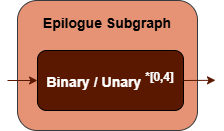
N=20, 0 to 20 Binary or Unary operations are supported in the epilogue subgraph.
Data Types#
oneDNN supports the following combinations of data types for src and dst:
src |
dst |
|---|---|
f32,bf16,f16 |
f32,bf16,f16 |
The definition of the data types and support status on different CPU and GPU platforms follow the general description in the Data Types Guide.
Implementation Limitations#
The Interpolate operation only supports half_pixel coordinate_transformation_mode.
Implementation Notes#
Post-binary Add operations in the epilogue subgraph support in-place operations when the post-binary Add is the last operation in the epilogue subgraph and the dst output shape is identical and data type size is the same as the binary Add input. In case of an in-place operation, the original input data will be overwritten. Use in-place operations whenever possible for performance.