
Introduction#
Thread Composability Manager (TCM) is a project that helps different threading runtimes, such as oneTBB and OpenMP, co-exist in one application by limiting platform oversubscription that could occur otherwise.
Why TCM?#
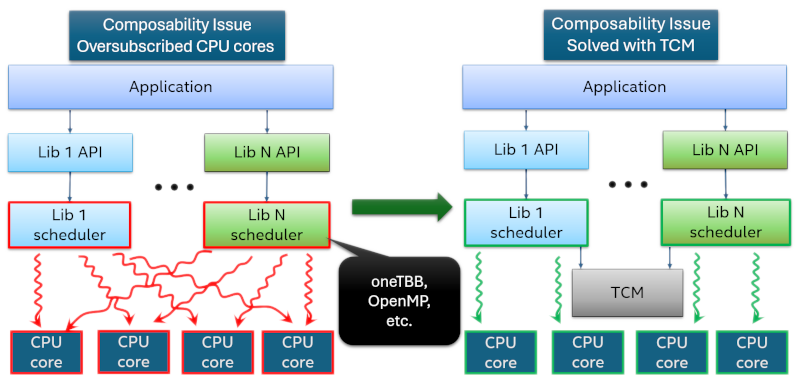
Each threading runtime typically sizes its thread pool to the number of hardware threads available on the platform. This works well while the runtime is the only one in the process, but modern applications are often composed of libraries that use different runtimes, for example, an application parallelized with oneTBB that calls into a math library parallelized with OpenMP. When several runtimes are active at the same time, or when parallel regions of one runtime are nested inside parallel regions of another, the total number of active threads can greatly exceed the number of hardware threads. This situation is called oversubscription.
Oversubscription degrades performance: the operating system has to time-slice threads, which adds context switching overhead, destroys cache locality, and can stall threads that hold locks or that other threads wait for. As a result, an application composed of well-tuned parallel components may run slower than its sequential counterpart.
Configuring each runtime independently, for example, by statically limiting the number of threads of each runtime, does not solve the problem well. Static limits leave hardware idle when only one runtime has work to do, and they require the application developer to know about every runtime used inside every library.
TCM solves this by acting as a single, process-wide coordinator. Runtimes that integrate with TCM ask it for resources before using them and give them back when they are no longer needed. TCM dynamically distributes the available resources among the runtimes so that, together, they use the platform fully without oversubscribing it. Application developers benefit without changing their code, since the integration is done inside the runtimes. TCM targets general-purpose multi-core CPU platforms, ranging from desktop systems to servers.
Key Concepts#
- Resources
CPU resources of the platform, that is, the hardware threads (logical processors) available to the process. The amount of resources is expressed in the number of software threads that can run simultaneously on them without oversubscribing the platform.
- Client
A threading runtime, such as oneTBB or OpenMP, or any other component that manages its own threads and connects to TCM to coordinate its resource usage with others.
- Permit
The object through which TCM communicates resource allocations to a client. A client requests a permit by describing the minimum and maximum amount of resources it needs, and TCM fills in the permit with the amount of resources the client is allowed to use. A permit has a state, for example, active, idle, inactive, or pending, which tells the client whether and how it can use the granted resources.
- Concurrency
The number of resources granted to a client in a permit, that is, the number of software threads the client is allowed to run in parallel.
- Callback
A function the client registers when connecting to TCM. TCM invokes it to notify the client that the permit has changed, for example, because more resources became available or because some resources must be returned.
Design Principles#
The purpose of the Thread Composability Manager is to distribute CPU resources between multiple clients. The clients can request resources in arbitrary order, including nesting of the requests. The following principles define how TCM behaves and what it expects from its clients.
The Thread Composability Manager (TCM) is not aware of what its clients are. It treats them equally, providing the interface to ask for new resources, adjust usage and release previously permitted resources.
TCM does not allocate or deallocate resources. Its sole purpose is to coordinate usage of resources across its clients. A client is expected to request a new portion of resources as demand for those appears, and to release these resources once the work is done and no new demand is foreseen. Threads that utilize these resources are created by the clients as needed.
Note
TCM makes no assumptions about which threads – from the application or from a client’s thread pool – utilize the granted concurrency. Clients should adjust the concurrency value as needed, taking into account application threads that are going to participate in a parallel region.
It is the responsibility of the client to follow the negotiated permits. TCM assumes its clients are well-behaved and neither ignore nor abuse their resource permits.
TCM resolves resource requests in accordance with global restrictions set for the process (such as affinity masks). In other words, TCM respects constraints on the resources imposed on the application.
TCM provides no “independent progress” guarantee for its clients, that is whether and when a request for resources is satisfied depends on the resource usage by other clients.
TCM provides no formal fairness guarantee for its clients, though the implementation applies fair strategies where appropriate.
In case of not being able to fully satisfy the request, TCM may:
Reject the request, that is permitting no use of additional resources.
Partially satisfy the request, possibly by taking back some of the earlier permitted resources from previous requests and thus balancing resource usage across its clients.
Note
These situations are considered normal behavior, not an error or exception.
In case of not being able to satisfy the requested minimum, TCM lets the client know this by assigning
TCM_PERMIT_STATE_PENDINGstate to the permit, allowing clients to wait until the necessary minimum becomes available.Resource availability changes over time as clients request and release resources. To let clients follow these changes without polling, TCM rebalances resources asynchronously and notifies the affected clients through their registered callbacks. In particular, if unsatisfied or partially satisfied requests exist and unused resources appear (e.g. released by another permit), TCM invokes the callback of the corresponding clients to better satisfy their requests.
TCM may also invoke the callback to revoke some resources previously granted above the requested minimum, for example, to give them to another client whose minimum is not yet satisfied.
Note
Since clients cannot immediately react to reduced set of resources which was initially negotiated, it is expected that these clients will reduce the resources usage as soon as execution allows. Depending on the chosen resource distribution strategy, it may happen that the system is oversubscribed for a limited time.
Where to Go Next#
Get Started with TCM describes the prerequisites, how to build and install TCM, and how to enable it in an application.
TCM Developer Guide explains the usage model a threading runtime should follow to integrate with TCM, the permit state transitions, and common composition scenarios. It also contains complete usage examples that can serve as a quick start.
TCM API Reference provides the detailed description of TCM functions and data structures, including permit requests.
Showcasing TCM videoclip - End Parallel Runtime Scheduling Conflicts