
make_edges function#
[flow_graph.helper_functions.make_edges]
Note
To enable this preview feature, define the
TBB_PREVIEW_FLOW_GRAPH_FEATURES macro to 1.
The make_edges function template creates edges between a single node
and each node in a set of nodes.
There are two ways to connect nodes in a set and a single node using
make_edges:
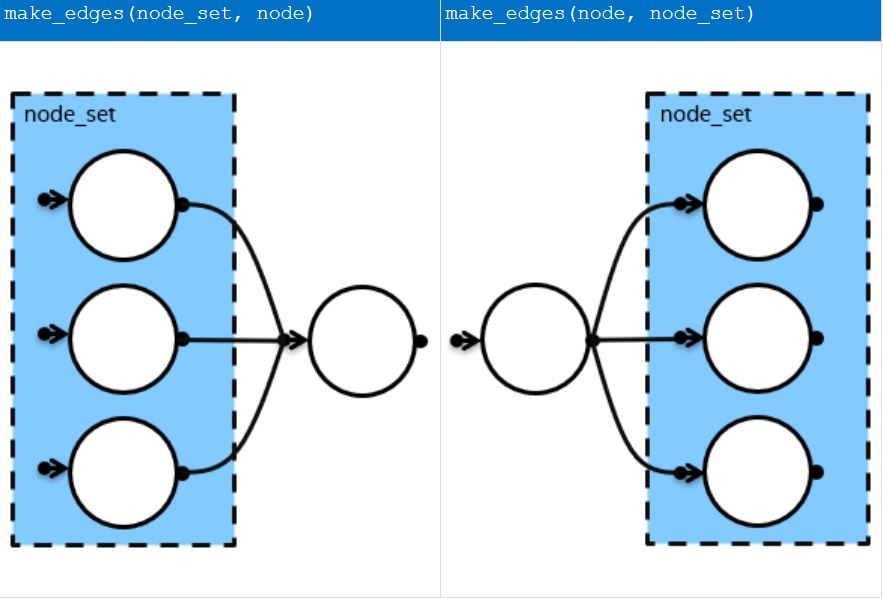
Syntax#
// Defined in header <oneapi/tbb/flow_graph.h>

namespace oneapi {
    namespace tbb {
        namespace flow {

        // node_set is an exposition-only name for the type returned from make_node_set function

        template <typename NodeType, typename Node, typename... Nodes>
        void make_edges(node_set<Node, Nodes...>& set, NodeType& node);

        template <typename NodeType, typename Node, typename... Nodes>
        void make_edges(NodeType& node, node_set<Node, Nodes...>& set);

        } // namespace flow
    } // namespace tbb
} // namespace oneapi
Example#
The example implements the graph structure in the picture below.
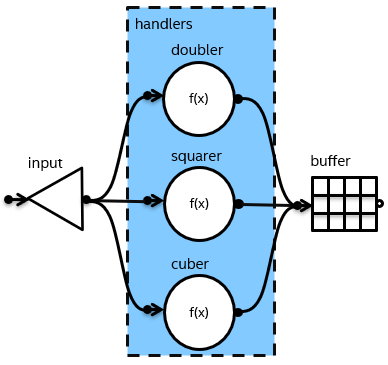
#define TBB_PREVIEW_FLOW_GRAPH_FEATURES 1
#include <oneapi/tbb/flow_graph.h>

int main() {
    using namespace oneapi::tbb::flow;

    graph g;
    broadcast_node<int> input(g);

    function_node doubler(g, unlimited, [](const int& i) { return 2 * i; });
    function_node squarer(g, unlimited, [](const int& i) { return i * i; });
    function_node cuber(g, unlimited, [](const int& i) { return i * i * i; });

    buffer_node<int> buffer(g);

    auto handlers = make_node_set(doubler, squarer, cuber);
    make_edges(input, handlers);
    make_edges(handlers, buffer);

    for (int i = 1; i <= 10; ++i) {
        input.try_put(i);
    }
    g.wait_for_all();
}